
Schools and Colleges | Shopping | Clubs and Charities | Genealogy | Stourbridge Area | Business | Links | Lots more stuff | Contact | Homepage
Theatres and Cinemas of Stourbridge, 1752 - 1952
3 - The Dawn of Cinema
A Partnership
However, to get back to the 1910 era. Six months after the opening of the
Temp, at Lye, we find Douglas Phelps joining in partnership with Alfred Wall
in a venture which provided Stourbridge with its first all-cinema. The Empire
Picture Hall was situated in a warehouse of the old Brewery Company in duke
Street, Stourbridge, and had a grand opening by invitation on October 3rd
at 3.00pm., followed by twice-nightly performances at the princely prices
of twopence, fourpence and sixpence. Mr Wall apparently managed both cinemas.
By 1911 it had become the Empire Picture Palace and at a still later date, the New Picture Hall. As I remember it, the auditorium was long and narrow with a raked floor. There was only one projector, as usual, and during reel changes a Mr. Weaver, who had been a pianist at the Alhambra, obliged down front, while the girls dispensed ginger beer, chocolates, cigarettes and oranges. No theatre of that period was complete without the smell of oranges. How long the Empire lasted I do not know, but by August 12th 1912 the Alhambra was advertising a special attraction for the following week: “The Tale of Two Cities – Must be seen to be believed! Phelps Famous Electric Pictures”. This is the first mention of a full length feature film and was soon followed by “The Keys of Calais”. Less than three months later the main attraction was, of course, Phelps answer to his new rival, The King’s Hall – for on the previous Friday Messrs. Pooles had made an application before the magistrate’s court for a licence to hold theatrical performances and film shows at the converted skating rink in New Road. After inspection, a licence was granted for five months.
An Incentive
This is interesting, and suggests that Pooles may have had some doubts as
to whether this 1,500 seater theatre was going to be a paying proposition
with films, and it must have been a bit of a gamble, even with variety acts
to back it. The cinema was opened the following Monday, at prices ranging
from twopence to eightpence, with children’s matinees half price and,
as an incentive to the latter, on many occasions there was a gift of a bag
of sweets or an orange upon entering.
At this time there was only one entrance (from New Road) but months later
an arrangement was made with the owners of Longcroft Buildings in High Street
to use their carriageway for a main entrance. There were gates at this point
which were locked at night for many years, and also during the weekend to
prevent it becoming a right of way.
However, this access to the High Street created the battle of the barkers.
For years the Alhambra barker, resplendent in his gold-braided uniform, had
held court in splendid isolation in the High Street, cajoling all who would
partake of “early doors to all parts” or in such flowery language
at his command, to persuade the bystander to while the hours away in the hand
of make-believe, but with the new opposition across the street, it soon became
the battle of the biggest voice.
The Titanic
Alas, these flamboyant characters now seem to have left the world of entertainment,
except perhaps on the fair grounds. Despite the fact that Messrs. Pooles had
their new cinema, their myorlarmas continued to visit the town till November
1912, and upon that occasion we had a very fine dramatic presentation of the
sinking of the Titanic. A second week was played with “a grand picture
concert, Lieutenant Shackleton’s South Pole expedition to be followed
by “amazing dissolving limelight illustrations” to songs by Miss
Nancy Cameron (soprano) and Mr. Chas. Wade (baritone)
As I remember it, the projector box was a flimsy sheet steel set up in the
centre of the Town Hall and, as stated in the advertisement, the machine was
lit by limes, for it was not until 1923 that the gas lighting was exchanged
for electricity. It seems hard to realise that at the end of the First world
War very few shops in the High Street were wired for electricity and that
houses even along Hagley Road had their own generating sets.
A Turning
Point
The year 1912 was the turning point in the new industry, for long feature
films were beginning to come out of France and America. Up till then the films
had mostly been of the news reel type, or short comedies. Fred Karno, one
of the great names in the theatrical comedy world, had a number of companies
from his famous fun factory touring the globe, and was getting desperate with
his American shows, for as fast as he sent a new comedian out, the film companies
were draining them off.
No doubt his greatest loss, and the cinema’s gain, was when Charles
Spencer Chaplin was eventually lured to Hollywood. Karno had considered sending
his brother Syd Chaplin out to fill the gap in “The Mumming Birds”
but as he thought he was too valuable at home, decided to take a chance with
his younger brother Charles. He stepped up his salary from a few shillings
a week to £15 and lectured him about his loyalty to the Karno firm.
To give him his due, Charlie resisted the mounting offers of the film producers
for two years, but finally succumbed. He left Kansas City for Los Angeles
and joined up with Keystone. His first picture did not even carry his name,
and was simply called “A Keystone Comedy: Making a Living”. He
couldn’t have had a more apt tile to start off with.
The Old Tivoli
There was an interesting news item in 1909 of a “grand exhibition of
animated pictures” on December 20th at the Drill Hall, Halesowen, of
military subjects, held before the regimental officers and ranks of the Worcestershire
Regiment, with music performed on stage by the regimental band.
In May 1912 Messrs. Pooles converted the old Tivoli Theatre in Brierley Hill
into a picture house, and renamed it The Queen’s Hall, with “Pooles
Perfect Pictures” their slogan for many years. The opening programme
was extensive, the main attraction “The Victoria Cross” or “The
Charge of the Light Brigade”, showing Queen Victoria and Florence Nightingale,
etc. “One of the greatest pictures ever filmed” it was claimed.
It was also supported by six shorts – quite a programme!
Just in time for Christmas that year, we saw the opening at Wordsley of the
Olympic Electric Theatre on December 23rd, for the entertainment of Wordsley’s
inhabitants. This it did for many years, but has finally joined the rest of
the derelict picture houses.
The King’s Hall continued in the ascendancy throughout the war years
as purely a cinema,but films at the Alhambra became fewer and fewer, except
for an occasional short, or local interest film. On one or two occasions a
visiting theatrical company would make such a one as an added attraction.
I well remember one being made in the High Street when the visiting comedian
pinched a fish from Walter Perry’s slab, and was chased down the town
by Walter, complete with straw boater and striped apron. The Mayor’s
Civic Sunday procession was another regular film occasion, and I remember
well the pushing and shoving that went on to get in front of the camera position
on route.
The theatre never really settled for film, and I think the last one shown
was during a Canadian Pacific railway campaign to attract settlers to Canada
during 1924. By this time the film industry had really settled down and was
becoming to be accepted as an art form, although the daily newspapers did
not appoint the first film critics until 1921.
Harry Morris
In 1919 a site was purchased by a local company and a new cinema was erected
in Lower High Street. The Scala was opened towards the end of the year by
Miss Isobel Elsom, one of the reigning film stars of the British film industry.
Harry Morris, who became a very popular figure in the town, was appointed
manager and an excellent orchestra under Charles Bye offered competition to
Norris Stanley, who was playing at the King’s Hall. Yes, the cinema
provided us with first class orchestras in those days. Both of these leaders
have made their mark in the musical world since then.
One of the films shown there in the early 20’s called “Kissing
Cups Race” was based on a monologue of that name and Harry Morris, who
was an elocutionist, gave a spirited rendering of it before the film show.
The Scala, which seated 1,000 has of course changed hands since then and was
re-christened the Savoy in 1943. Harry Morris had left the cinema some years
before to manage the King’s Hall, changing places with Harry Wharton.
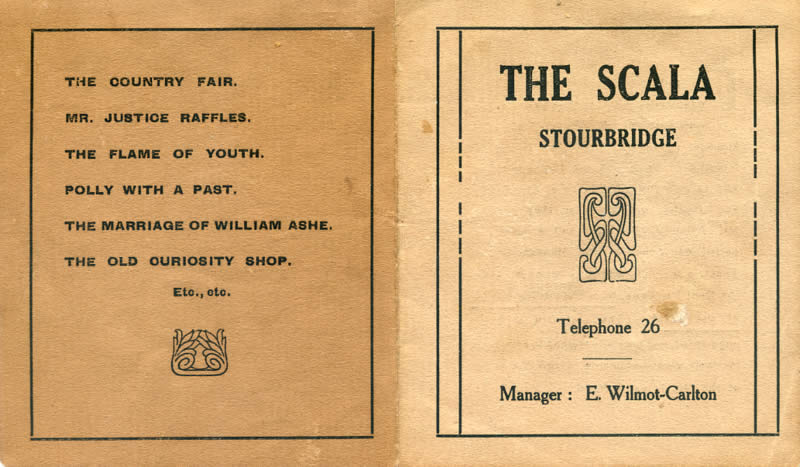
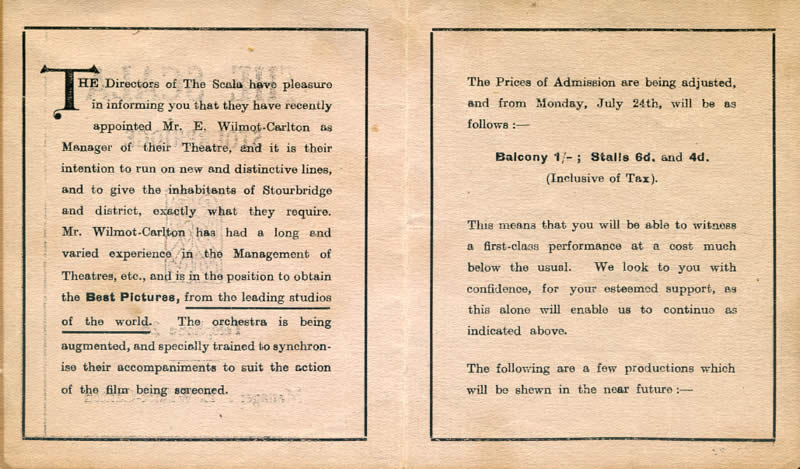
A reader has kindly supplied this early leaflet for the Scala, note the phone number! Research the films listed on the back suggests this dates back to the early 1920's.
Please click for larger image
“The
Central”
These two cinemas served the town for another ten years until another local
company, having bought a portion of the Fair Ground and the old Conservative
Club in High Street, built one on modern lines called “The Central”.
This, in turn, changed hands in 1938 and was re-christened “The Odeon”.
This theatre had a seating capacity of 1,400 and still flourishes* (later
became incorporated into the “Owen Owen” department store, formerly
“Stringers” and eventually demolished). During its construction
a very bad accident occurred when a girder got out of hand and sent several
of the erectors crashing to the ground.
Eleven years
later, with sound film booming, we had yet another cinema, a commodious 1,500
seater built in Hagley Road which we know as the Danilo. In the late 20’s
the Alhambra finally closed its doors. The new “Central” was the
final blow. When Phelps retired the theatre had been taken over by Mr Ray,
but the post-war years, like the recent ones, were bad times for the theatre,
and when the sound films burst upon us about ninety per cent of British theatres
either closed down or changed over to the “flicks”. Today the
wheel has turned full circle, and we fine the cinema struggling for existence
against the new medium, television. The King’s Hall has joined the Alhambra
with many regrets from the older inhabitants.
The Alhambra was always a joy to play in for the tiniest whisper could be
heard everywhere. With its low ceiling, covered with painted canvas, and the
long horseshoe gallery, which terminated only a few feet above the stage,
it was an intimate place.
I remember the shock I had when playing for the first time at the King’s Hall. After the easy intimacy of the Alhambra stage the change to the cinema with its large auditorium stretching away into the blackness, was terrifying, and my small voice, quite adequate for the theatre, had to work overtime to reach the little man in the balcony at the cinema. The nearness of the balcony at the theatre made it an ideal place for the first entrance of Dick Whittington’s Cat whenever we had it in pantomime, for invariably the cat leapt from the balcony to the stage, and I recall an altercation one Saturday night when a drunk leaning from the end seat whipped the hat off an actor standing at the side of the stage. They almost came to blows.
Famous Stars
Sir Cedric Hardwick made his first public performance there, and during Armistice
week in 1918, an up and coming star was appearing there in her husband’s
show “Mr Tower of London”. Yes, Gracie Fields has become a worldwide
star since then. I also saw Haydon Coffin – The Harry Welchman of the
1900’s – appear there in a play called “Betty”, which
has had a recent revival. Also about the same time Dan Rollyatt, the creator
of “Simplicitas” in “The Arcadians” came up to play
his original part for a touring company, whose comedian had been taken ill.
I have also met a number of well-known radio actors who have given me their
impressions of the last of the wooden theatres.
The King’s Hall too, provided us with many fine variety acts. One or
two which came to mind are the first of the chimpanzee acts “Consul”,
the Great Packman with his travelling organ, and Dr Bodie with his radio-controlled
airship which sailed around the cinema, and, of course, our first personal
appearance of a film star, Aurele Sydney, who paid us a visit during the showing
of his picture, “Ultus, the man from the dead”.
In later years we had visits, of course, from the Broadwest team, including
Walter West himself who was directing some exterior shots for a film at Oldnall
Colliery. With him came Stewart Rome and Violet Hobson.
“Bladys
of Stewponey”
While they were in Stourbridge, Harry Wharton organised a film ball at the
Town Hall and, together with the Broadwest cast, we also saw Gregory Scott
and Milton Rosmer. The company later returned to Stourbridge to make “Bladys
of Stewponey” based on the Rev. Baring Gould’s book. This was
not a very successful film.
A number of structural alterations were made to the cinema during its lifetime, including the removal of the floor during a week-end and re-fitting with a new saucer-shaped one which improved the sight line of all seats. Later the theatre was completely rebuilt, an outstanding building job, for the theatre only closed for about seven days while they removed the old one from inside the new structure. In this cinema we were first introduced to “taking pictures” two or three years before they became a commercial proposition and in the same year we also witnessed “3D” pictures, using polarised glasses, an innovation twenty years before its time.
Yes, there can only be a great regret at the passing of both of these places which have given the inhabitants so much pleasure in entertainment.

Stourbridge Lion | Music | Sport | Long Lost Friends | Clubs and Charities | Pubs | Schools and Colleges
Genealogy | Stourbridge Area | Business | Links | Lots more stuff | Contact | Homepage

